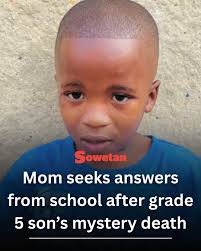
School negligence allegations have emerged following the death of five-year-old Manqoba Mnisi, a Grade R pupil at Bernard Isaacs Primary School in Johannesburg. The child was reportedly injured on Monday, 2 February, during a school function and later died in hospital. The Gauteng Department of Education has appointed an independent law firm to investigate the circumstances, as community anger grows in South Africa.
The case has sparked protests outside the school, with family members insisting they have not been given truthful information about what happened.
What Happened on 2 February?
According to the family, Manqoba Mnisi was allegedly left alone in a classroom during a school function. It was during this period, they claim, that he sustained injuries.
He was later transported to hospital, where he died.
However, the exact circumstances remain disputed.
Family members say the school initially told them that the child fainted near the toilets. They question that explanation, stating that visible injuries — including blood near his mouth — suggest something more serious occurred.
The conflicting accounts have intensified scrutiny and fueled allegations of possible school negligence.
Family Demands Justice and Transparency
Manqoba’s aunt, Phumla Malandisa, has publicly expressed the family’s frustration.
“We need justice and answers about what happened that day,” she said.
She further questioned the school’s version of events, arguing that it does not align with what the family observed.
“We just want the truth, because now there are many conflicting stories,” she added.
For the Mnisi family, the issue is not only grief but clarity. They want a detailed timeline explaining:
- Who was supervising the child
- Why he was allegedly left alone
- How the injury occurred
- When emergency assistance was called
- What immediate aid was provided
The family’s concerns have resonated widely within the Coronationville community.
Community Protests Intensify
Community members have gathered outside Bernard Isaacs Primary School, calling for accountability and transparency.
Protesters have demanded that authorities address concerns surrounding potential school negligence and ensure that no information is withheld.
Parents in the area have raised broader concerns about:
- Supervision during school functions
- Staff-to-learner ratios
- Safety monitoring in classrooms
- Emergency response procedures
While protests have remained focused on seeking answers, tensions reflect the seriousness of the allegations.
Education Department Launches Independent Probe
In response, the Gauteng Department of Education confirmed it has appointed an independent law firm to conduct a full investigation.
In an official statement, the department said the probe will ascertain the complete facts and circumstances surrounding the incident.
The investigation is expected to review:
- Supervision protocols during the school function
- Staff responsibilities at the time
- Incident reports and documentation
- Medical response timelines
- Communication between the school and the family
By appointing an external legal team, the department aims to ensure impartiality and credibility.
Gauteng Education MEC Matome Chiloane visited the family on Friday, offering condolences and reaffirming the commitment to transparency.
The independent law firm is scheduled to meet with the Mnisi family next Tuesday.
Legal and Policy Implications
Allegations of school negligence carry significant legal and administrative consequences.
If the investigation determines that proper supervision was not in place, or that emergency procedures were not followed, potential outcomes could include:
- Administrative action
- Policy revisions
- Disciplinary measures
- Enhanced safety regulations
Education law specialists note that cases involving minors demand thorough scrutiny to protect both accountability and due process.
At this stage, authorities have emphasized that conclusions should only be drawn once the investigation is complete.
Safety in Early Childhood Education
Grade R learners are typically five or six years old, making them among the most vulnerable students in the formal education system.
Schools are generally expected to maintain:
- Continuous adult supervision
- Clear emergency protocols
- Updated contact records
- First aid-trained personnel
During school functions, supervision responsibilities may shift, requiring careful coordination.
If a child was indeed left alone, as alleged, the investigation will examine whether established safety guidelines were breached.
Broader Impact Across South Africa
The case has reignited discussions about child safety within public schools across South Africa.
Parents rely on schools to provide not only education but protection.
Incidents involving young learners often prompt wider policy reflection and safety reviews.
Education analysts suggest that, regardless of the outcome, this case may lead to:
- Refresher safety audits
- Additional training requirements
- Strengthened supervision policies during school events
Public trust in the education system depends heavily on transparency during crises.
What Happens Next?
The independent law firm will gather statements, examine documentation, and assess compliance with departmental regulations.
The meeting scheduled with the Mnisi family is expected to form part of that process.
Officials have not provided a timeline for the completion of the investigation but have indicated that findings will be made public once finalized.
Until then, authorities are urging calm and discouraging speculation.
Conclusion
The death of five-year-old Manqoba Mnisi has left a family grieving and a community demanding answers. Allegations of school negligence have placed Bernard Isaacs Primary School under intense scrutiny, prompting an independent investigation by the Gauteng Department of Education.
As protests continue and questions remain unanswered, the focus now shifts to the findings of the external probe.
For the Mnisi family, justice means clarity. For the education system, it means ensuring that every child entrusted to a classroom is protected by strict supervision, transparent procedures, and unwavering accountability.
The coming weeks will be critical in determining not only what happened on 2 February, but whether safeguards were sufficient — and what changes may follow to prevent future tragedies.