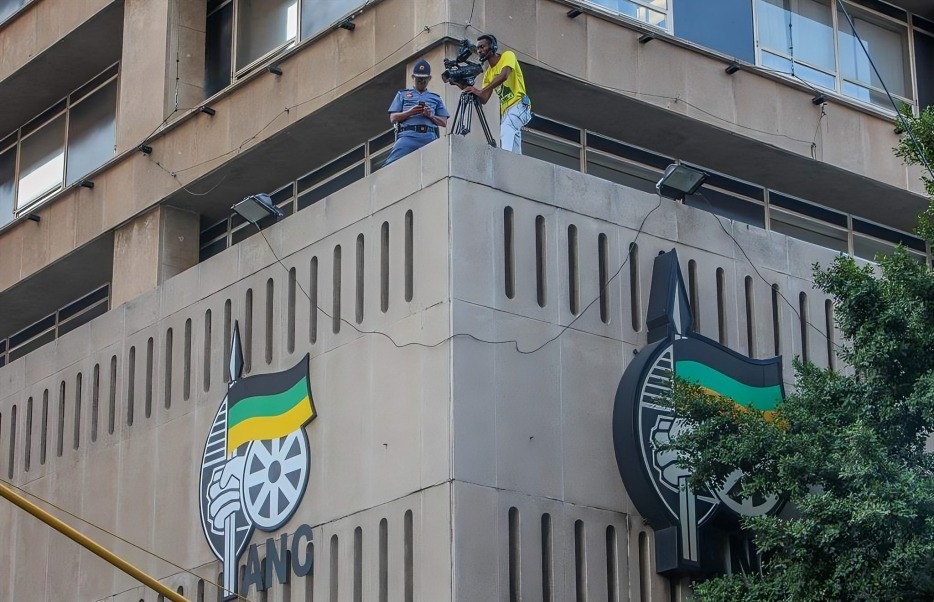
The debate around ANC Cleansing has intensified in South Africa after several senior figures within the ruling African National Congress reportedly proposed a traditional spiritual ritual at the party’s headquarters, Luthuli House, in Johannesburg.
The suggestion comes as the ANC struggles with declining political support following the 2024 South African general election, where the party lost its parliamentary majority for the first time since the end of apartheid. Some party insiders believe the headquarters may be under a form of “spiritual attack,” which they claim has contributed to the party’s recent electoral setbacks.
While the idea has sparked debate across political circles, analysts say the discussion highlights the deep internal crisis facing the ANC as it attempts to rebuild support and political unity.
What Happened?
The ANC Cleansing proposal reportedly emerged during internal discussions among senior party members concerned about the organization’s continued loss of influence. According to sources familiar with the matter, some leaders believe the headquarters may require a traditional cleansing ritual to remove negative spiritual forces.
Such rituals are common in parts of southern Africa and are typically conducted by traditional healers to cleanse a location believed to carry misfortune or spiritual disturbance.
In this case, supporters of the proposal claim that problems at Luthuli House began during the presidency of Jacob Zuma, who led South Africa from 2009 to 2018.
They argue that political divisions, corruption scandals, and declining voter trust during that period may have left the party spiritually vulnerable.
However, not all members of the ANC agree with the idea. Some leaders have reportedly dismissed the proposal as symbolic rather than practical, arguing that the party’s challenges are rooted in governance and policy failures rather than spiritual issues.
Political Context Behind the Proposal
The ANC Cleansing discussion comes at a critical moment for the party. In the 2024 South African general election, the ANC received just over 40 percent of the national vote, marking its worst performance since it came to power in 1994.
The election result forced the party into a coalition-style political arrangement to maintain control of the national government.
Political analysts say the loss was driven by several factors, including economic challenges, corruption scandals, and growing dissatisfaction among voters.
The rise of new political movements has also weakened the ANC’s dominance.
One of the most significant challenges has come from the UMkhonto weSizwe Party, a political movement backed by former president Jacob Zuma.
The party performed strongly in several provinces during the 2024 election, drawing support away from the ANC’s traditional voter base.
For some ANC members, this political shift has reinforced the belief that deeper forces may be affecting the party’s fortunes.
Cultural Beliefs and Political Tradition
In South Africa, traditional beliefs and cultural practices often intersect with politics.
Traditional cleansing rituals are widely practiced in communities across the country and may be used to address perceived misfortune, conflict, or negative energy.
Supporters of the ANC Cleansing proposal argue that performing such a ritual could symbolically reset the party’s direction and restore unity among its members.
In many cases, these rituals involve prayers, offerings, and the guidance of traditional healers who are believed to communicate with ancestral spirits.
However, political observers caution that while cultural traditions hold significance, they are unlikely to resolve the structural issues affecting the ANC.
Instead, they say the party must focus on policy reform, leadership renewal, and rebuilding public trust.
Reaction From Political Analysts
The suggestion of an ANC Cleansing has sparked mixed reactions from political commentators and members of the public.
Some analysts see the proposal as an example of how deeply the party’s internal frustrations run.
According to political analysts in Johannesburg, the discussion reflects the psychological impact of the ANC’s declining dominance in South African politics.
“For decades, the ANC was the uncontested political force in South Africa,” one analyst explained. “Losing that dominance has forced the party to search for explanations, including cultural or spiritual ones.”
Others argue that the idea risks distracting from the real issues facing the party.
They point to ongoing concerns about governance, economic inequality, and corruption as the primary reasons for the ANC’s electoral decline.
Public Reaction and Social Media Debate
The ANC Cleansing proposal has also triggered widespread debate on social media platforms across South Africa.
Some users have reacted with humor and skepticism, questioning whether spiritual rituals can solve political problems.
Others have defended the idea, saying traditional practices should not be dismissed simply because they intersect with modern politics.
Supporters of the proposal say cultural traditions remain an important part of South African identity and should be respected.
However, critics argue that political organizations must address practical challenges rather than relying on symbolic gestures.
What Happens Next?
It remains unclear whether the ANC leadership will formally approve any cleansing ritual at Luthuli House.
Party officials have not yet confirmed whether the proposal has reached the top levels of leadership.
In recent months, ANC leaders have instead focused on rebuilding voter confidence ahead of upcoming local elections.
Efforts include internal reforms, renewed anti-corruption initiatives, and outreach to communities where the party has lost support.
Whether the ANC Cleansing proposal moves forward or remains a symbolic discussion, the controversy highlights the difficult path ahead for South Africa’s once-dominant political party.
Conclusion
The ongoing debate over ANC Cleansing illustrates the complex mix of politics, culture, and internal uncertainty within the African National Congress. While some party members view a spiritual ritual at Luthuli House as a way to symbolically reset the organization’s fortunes, others argue that the ANC’s challenges stem from deeper political and governance issues.
As South Africa’s political landscape becomes increasingly competitive following the 2024 South African general election, the ANC faces mounting pressure to rebuild trust among voters and restore its political strength. Whether through symbolic gestures or structural reforms, the party’s next steps will play a critical role in determining its future influence in South African politics.
Ultimately, analysts say the ANC’s long-term recovery will depend not on rituals but on effective leadership, credible policies, and renewed public confidence in the party’s ability to govern.