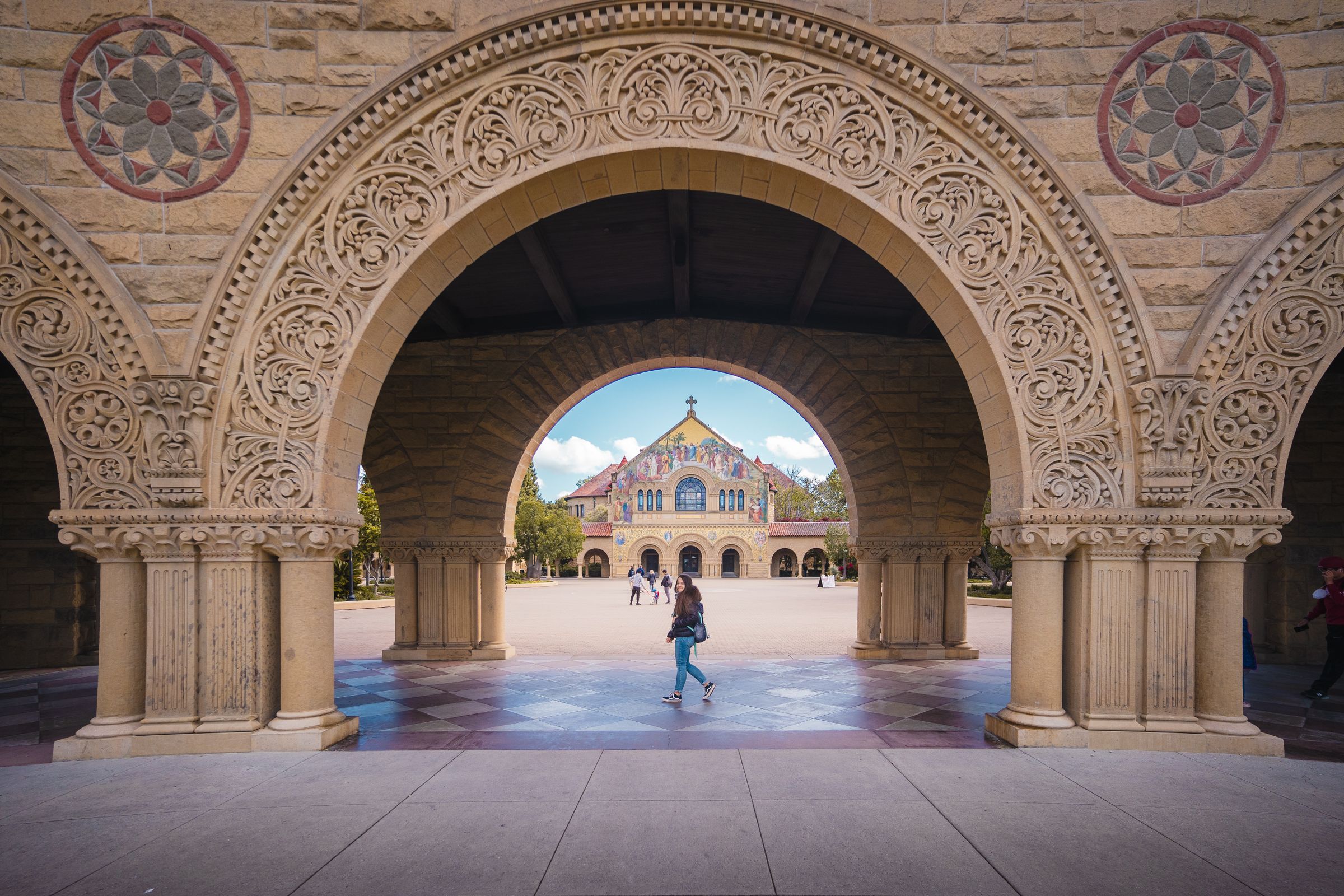
South Africa’s AI ambitions will live or die on delivery: power that stays on, transmission lines that get built, and partnerships that turn research into working companies. That was the practical message President Cyril Ramaphosa carried through a fireside chat at Stanford University in California, where he engaged academics, students and members of the university community on the country’s plans to harness AI, attract investment and strengthen its role in the global technology ecosystem.
The President arrived in Silicon Valley with a large delegation and framed the visit as a study in how an innovation ecosystem actually operates. What stood out, he said, was the way universities, researchers, entrepreneurs and investors work together to turn research into innovations and globally competitive companies.
“One thing I’ve learned is that an ecosystem has been created here, an ecosystem in which a university like Stanford participates in the creation of companies,” President Ramaphosa said.
He identified the relationship between academic research, innovation and venture capital as an important lesson South Africa can draw from the region. “What I have found most attractive here and something that we want to learn from, is that innovation has been driving what has been happening here in Silicon Valley … [As we head] back home, we can almost mirror what we have learned here,” the President said.
South Africa may not replicate Silicon Valley, he acknowledged, but the country can develop its own innovation ecosystem through partnerships between universities, researchers, entrepreneurs and investors.
A second lesson concerned execution, and the gap between ideas and implementation. “The other important thing I’ve learned here is the speed of execution. In Silicon Valley, people come up with ideas and they run fast to implement those ideas,” he said. “We are often held back by bureaucracy in South Africa. Being here, one has learned that speed is what is important in executing very good innovations. We need to get rid of bureaucracy because bureaucracy tends to hold back the execution of ideas.”
On the infrastructure side, the President pointed to improvements in the country’s electricity generation capacity as a foundation for attracting investment in data centres, which he described as critical infrastructure for AI and other digital technologies. “We now have excess power and we are now able to attract investors who want to come and set up data centres in South Africa,” he said.
Several international technology companies, including Amazon and Google, are establishing data centres in the country, alongside South African businesses. “South Africa is open to the creation or establishment of data centres. Other countries believe the United States is shunning those. And we say to those who want to establish data centres, bring them to South Africa,” the President said.
Hosting alone is not the goal, though. Investment in data centres, he emphasised, should be accompanied by opportunities for South African businesses, researchers and innovators to participate in the broader technology value chain. “But when you do, just expect that we are a country that is hungry for partnership, a country that wants to participate in the entire value chain, and not just to have data centres planted in South Africa,” he said.
That distinction ran through his broader remarks on AI. South Africa, he said, is determined to embrace technology while ensuring that local talent, research institutions and businesses participate in its development. “We no longer just want to be recipients of those technologies. We want to participate in their origination and innovation, so that as we participate in the full value chain. We would like Africa as a whole to be great participants and not be followers of what is generated elsewhere,” the President said.
He argued the country has the necessary foundations to contribute to the global AI ecosystem, including skilled researchers, world-class universities and research institutions. “We have the capability and great talent in our country. Our world class universities, a number of them, are highly rated universities that have produced many scientists, many researchers, and we want to participate in that full value chain,” he said. Participation in the AI value chain, he added, can also help address pressing socio-economic challenges, including unemployment and inequality.
Responding to a question about government strategy, the President said government is seeking to build partnerships with global technology players and with South Africans living abroad, drawing on the skills, investment and networks of the diaspora to support young entrepreneurs and innovators at home. “Our approach to AI is that this is a technology that we have to embrace, that we have to utilise, and that we want our young people to be deeply immersed in, because we see a lot of good that AI has to offer. Of course, there are risks,” he said. The visit, he added, had strengthened his conviction that the country should approach AI with confidence while putting measures in place to manage its risks. “So, we go back home not fearful of AI. We go back home embracing AI and wanting to utilise AI for the development of our country and our people. So, we go back home stronger, but we also go back home, hopefully with a bag full of investments,” the President said.
On energy delivery specifically, he said South Africa is investing in expanding its infrastructure, including the development of 14 000 kilometres of transmission lines and increasing renewable energy generation. He also identified the Council for Scientific and Industrial Research (CSIR) as one of the country’s institutions producing important innovations, and said research capabilities, coupled with investment and international partnerships, could provide a strong foundation for technological advancement. “What we need is investments that will match the research capability that is emerging out of South Africa, and to partner with the people or entities here in Silicon Valley [that] will produce a very powerful enabler for us in South Africa,” he said.
To sustain what the visit has started, the President revealed that government is considering establishing a liaison presence in Silicon Valley to serve as a business development bridge between the technology hub and South Africa. The initiative is intended to keep the relationships and opportunities created through the Presidential visit alive, and it will be the mechanism to watch as the delegation’s promises move from fireside chat to execution.